
Active Warrants in Monroe County
An active warrant is a court order that still stands. It has not been served, recalled, or quashed by the issuing court. Iowa dockets get more specific than that, though, using terms like arrest warrant, warrant for failure to appear, warrant returned, or order for arrest. Never assume the word "active" from an old entry alone. The free Iowa Courts Online docket can reveal filed events in a Monroe County case, and the Clerk of Court can explain what the filed record means. The Sheriff/Jail works the enforcement and custody side of the same warrant. Read those sources together, because a docket is a case history rather than a live warrant database, and the gap between them is where confusion grows.
No Monroe Active Warrant Roster
Monroe County publishes no public active-warrant list, searchable database, sheriff app, or complete most-wanted roster. The sheriff's official page works as a contact and service route only, with no name-search field or download. Confirmation runs through the offices, not a page.
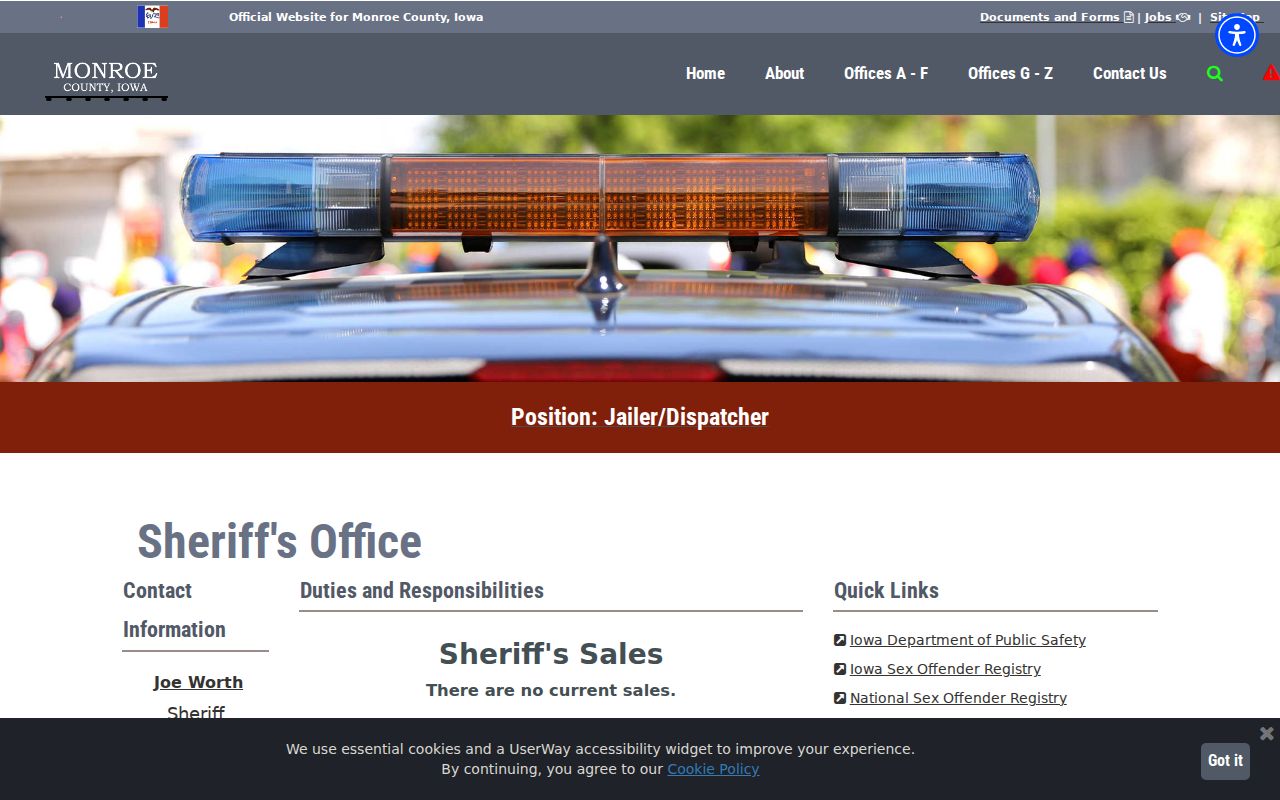
Monroe County publishes no roster of active warrants, so no names, photos, or warrant details appear on any public list.
Local finding: A reader cannot clear or disprove a Monroe County active warrant by checking a county roster because no such official roster is published.
Begin with the public docket, then call the Monroe County Clerk at 641-932-5212 and the sheriff at 641-932-7815. Ask about the exact case and which office can confirm its current warrant status.
How the Monroe County Active Warrant List Works
No public Monroe County active warrant list comes with a stated update schedule. The closest public source is a court docket kept through Iowa clerk offices, where a filed event may appear after a judge issues an order, after service, or after some other case step. Confidential material stays hidden no matter how many times a name is searched. On the enforcement side, agencies rely on the IOWA System, which links more than 450 Iowa justice agencies and NCIC. The public cannot self-search it. The sheriff serves as the local contact for enforcement questions in Monroe County, and a blank docket result is not proof that no active warrant exists.
Monroe Docket Versus Active Record
A court docket and an enforcement record answer different questions in Monroe County. Treating a public case index as the sheriff's live operational system is a common and costly mistake.
| Source | What it may show | What it cannot prove |
|---|---|---|
| Iowa Courts Online | Public case and docket events | That no unlisted warrant exists |
| Clerk of Court | Filed status, case ID, hearing, payment, recall or quash entry | Every live law-enforcement action |
| Sheriff/Jail | Local service, custody, confirmation, and surrender routing | Status of every other county or federal warrant |
| IOWA System | Agency warrant and article exchange | No public access is offered |
A careful Monroe County active warrant check therefore crosses both sides, court and enforcement alike.
What a Monroe Active Warrant Shows
Monroe County publishes no live local warrant list. Field labels below come from Iowa forms, statutes, and docket practice instead of an invented search screen. A filed record may carry some of these concepts.
| Case ID | The court’s 17-character identifier for a known case. |
|---|---|
| Warrant event | Issued, returned, recalled, quashed, or another status entry. |
| Charge or citation | The matter connected to the order. |
| Issuing court | The judge or magistrate within Iowa District Court. |
| Bond or conditions | Terms may appear, subject to judicial discretion. |
| Status date | The date of the recorded event, not a guarantee of live status. |
Note: Record the exact words and date on any Monroe County warrant entry, then ask the issuing court and serving agency what they mean now.
Why Monroe Warrants Can Be Missing
Iowa Code section 804.29 generally keeps information used to secure an arrest warrant confidential until arrest and return or initial appearance. A fresh or pre-service warrant may thus stay out of public view. Juvenile records, protected cases, and ongoing-investigation material can also be withheld or redacted. Other gaps are practical. A search may target the wrong county, a name variant may fail, or data may lag. The warrant might also belong to another Iowa county or a federal case, and a local Monroe County docket search cannot reach those systems.
Do not rely on silence: Confirm current Monroe County active warrant status with the clerk and sheriff before taking action.
Most-Wanted Lists and Warrant Roundups
Monroe County has no official most-wanted program page, Crime Stoppers roster, reward schedule, roundup notice, amnesty event, or update cadence. Names and photos should not be pieced together from scattered sources. Where an agency does publish a most-wanted list, it is a chosen public-safety subset, never the full set of active warrants. If a county, city, or sheriff program appears later, follow that agency's own page for current instructions and send tips only to the official agency. Call 911 for an emergency. Never approach a listed person. The lack of a Monroe roster changes nothing about the clerk-and-sheriff route for checking your own case.
Ask About a Monroe Active Warrant
Gather the full legal name, case ID or citation number, date of birth for a self-check, and the exact docket language before calling. The Monroe County Clerk of Court can locate a filed case, explain which parts are public, and say whether a warrant, return, recall, quash, payment, or new hearing appears in it. Ask the Sheriff/Jail which office handles local confirmation. If surrender may be required, request current instructions instead of assuming hours, required identification, or a bond process. The official sheriff source posts no warrant walk-in schedule and no after-hours procedure.
- Save the court case ID and newest event.
- Call the clerk about the filed court record.
- Call the sheriff about enforcement status.
- Consult an Iowa attorney before an appearance.
- Preserve every later order and verify both systems.
Monroe Active Warrant Status Terms
Status words mark steps in Monroe County records, not assumptions. "Issued" records court action. "Return" usually records execution or service, while recall or quash means the court withdrew the warrant. Payment settles a debt and does not equal recall.
- Active
- Still in force, subject to confirmation by the responsible office.
- Served or returned
- Execution or return has been recorded.
- Recalled
- The issuing court withdrew the warrant.
- Quashed
- The court ended the warrant by order.
- FTA
- Failure to appear at a required proceeding.
Use the most precise term the Monroe County record actually shows. Never label a warrant cleared without court and agency confirmation.
If Your Name Is on the Monroe List
Monroe County publishes no active warrant list, so a warrant usually comes to light through a docket entry or a call from an agency. Take it seriously at once. Do not pay a stranger who phones you. The Iowa Judicial Branch has warned about scams that invent a failure to appear and demand payment through odd methods. Instead, contact an Iowa attorney and the issuing court. A lawyer can help you weigh a new setting, a motion to recall or quash, authorized payment or compliance, bond, or an arranged surrender. The judge or magistrate decides the result. Never walk in without advice when arrest is possible. If you are arrested, Iowa Rule of Criminal Procedure 2.58 requires a magistrate appearance within 24 hours, or in every event within 48 hours if none is available. Once the matter is resolved, hold on to the papers. That means the recall or quash order, the receipt, the bond paper, or the new-setting notice. Recheck the docket and ask how the Monroe County sheriff's record will update. The Monroe County warrant records overview walks through the county resolution route.
Monroe County Active Status Follow-Up
After any Monroe County court appearance, bond, payment, recall, or quash order, keep the written proof. Recheck the docket. Ask the Clerk of Court whether the new event has been filed, then ask the Sheriff or jail how its enforcement record will update. These are separate checks. A receipt alone does not prove that every active warrant entry has been withdrawn, and a docket change may not reach each law-enforcement system right away.